Welcome to kde-learn’s documentation!
Kdelearn is a python library that gives you the ability to solve three fundamental tasks in data analysis:
classification,
outliers detection,
clustering.
All the procedures are based on kernel density estimation (non-parametric density estimation method) both in unconditional (standard) and conditional case.
Installation
Install kdelearn with pip:
$ pip install kdelearn
Example usage
import numpy as np
from matplotlib import pyplot as plt
from kdelearn.kde import KDE
from scipy.stats import norm

np.random.seed(0)

# Prepare data
x_train = np.random.normal(0, 1, (100, 1))
x_grid = np.linspace(-4, 4, 1000).reshape(1000, -1)

# Compute normal distribution on grid (x_grid)
norm_scores = norm.pdf(x_grid)

# Compute kernel density estimation on grid (x_grid)
kde = KDE().fit(x_train)
kde_scores = kde.pdf(x_grid)

# Plot
plt.plot(x_grid, norm_scores, label="normal distribution")
plt.plot(x_grid, kde_scores, label="kde")

plt.legend(fontsize=10)
plt.xlim(-4, 4)
plt.ylim(0, 0.45)
plt.xlabel("$x$", fontsize=11)
plt.grid(linestyle="--")
plt.show()
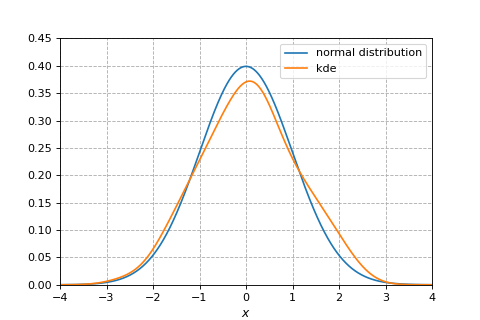
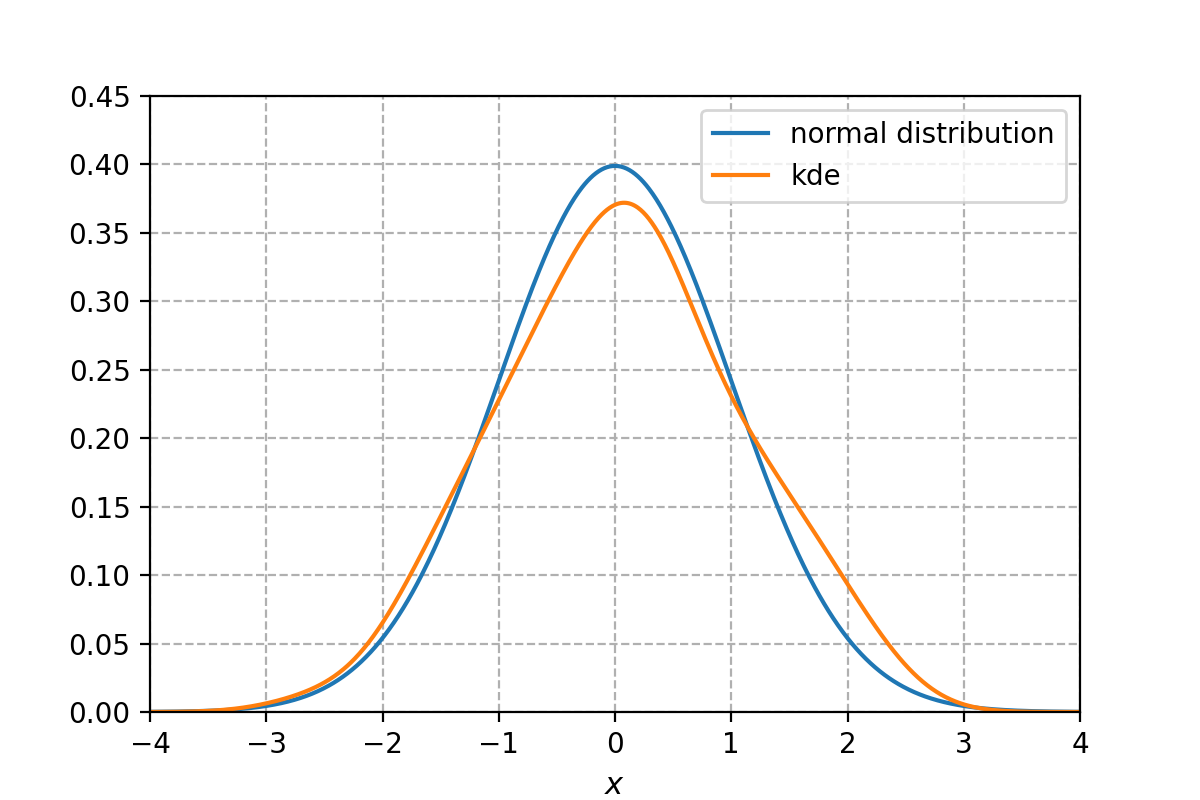
(Source code, png, hires.png, pdf)
Contents