Kernel density estimation
Kernel density estimation is a method for non-parametric density estimation.
On this page you can read about its unconditional (standard) and conditional form.
Unconditional case
Formula of unconditional kernel density estimation with product kernel:
|
|
Check available kernels.
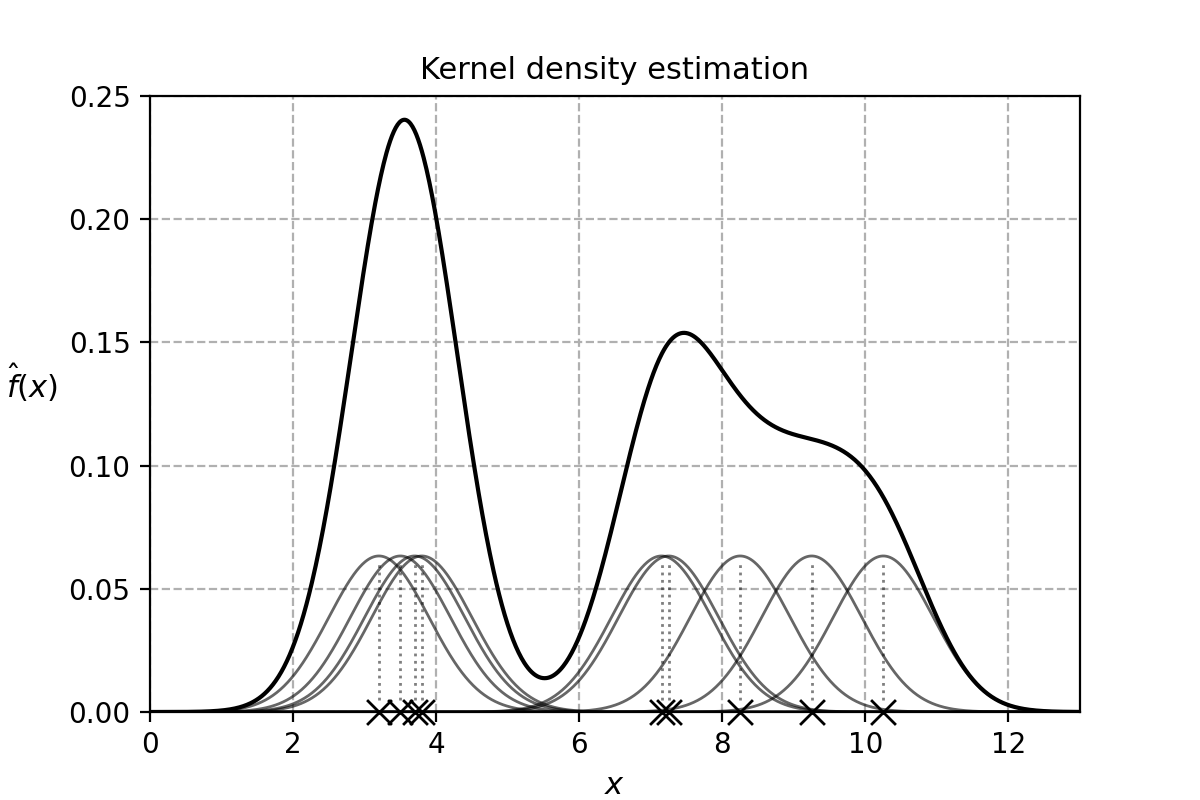
Example of constructing kernel density estimation on small dataset (\(m=9\)) with gaussian kernel:
Kernels
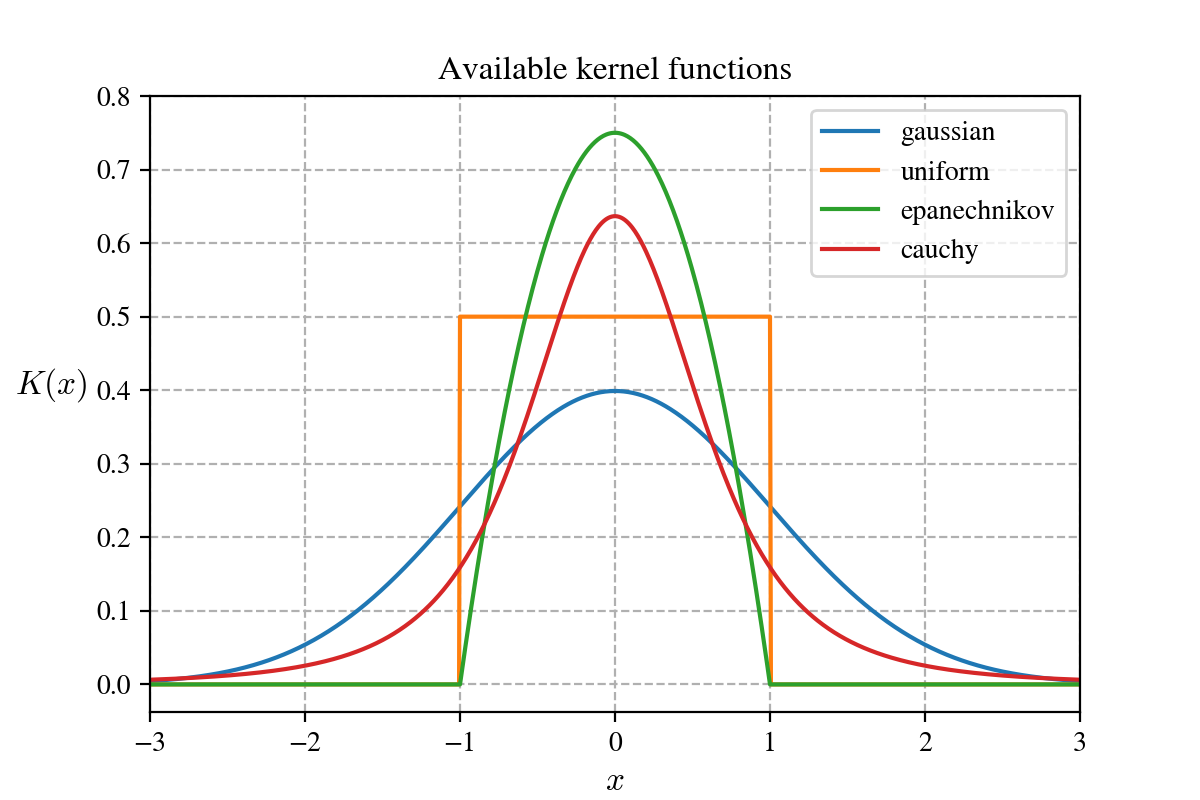
There are four available kernel functions. See formulas and plot below:
Kernel name |
Formula |
|---|---|
Gaussian |
\(\frac{1}{\sqrt{2 \pi}} \exp \left( \frac{x^2}{2} \right)\) |
Uniform |
\(0.5 \quad \text{if } |x| \leq 1 \quad \text{otherwise } 0\) |
Epanechnikov |
\(\frac{3}{4} (1-x^2) \quad \text{if } |x| \leq 1 \quad \text{otherwise } 0\) |
Cauchy |
\(\frac{2}{\pi (x^2 + 1)^2}\) |
Weighted data
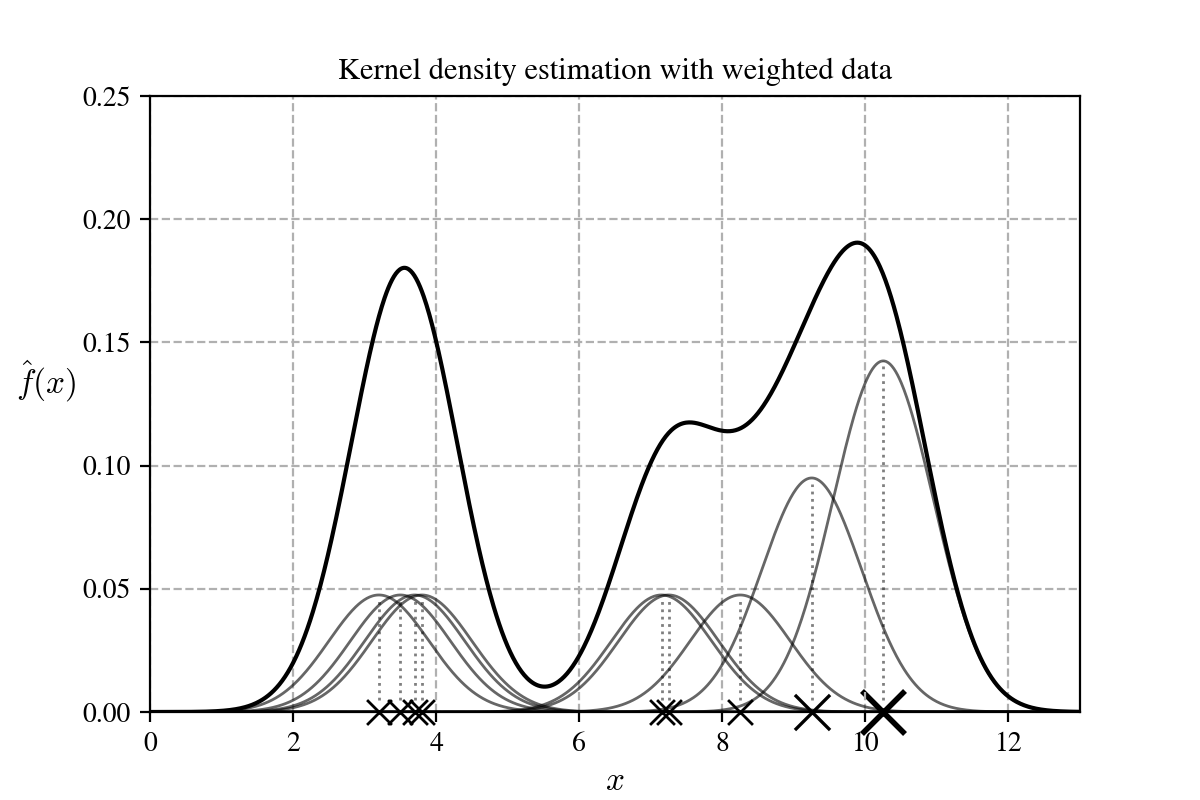
Example of constructing kernel density estimation with weighted data points.
Notice that the rightmost data points have more impact on estimated density than others.
Bandwidth selection
There are four available bandwidth selection methods:
normal reference
direct plugin
solve-the-equation plugin
maximum likelihood cross-validation
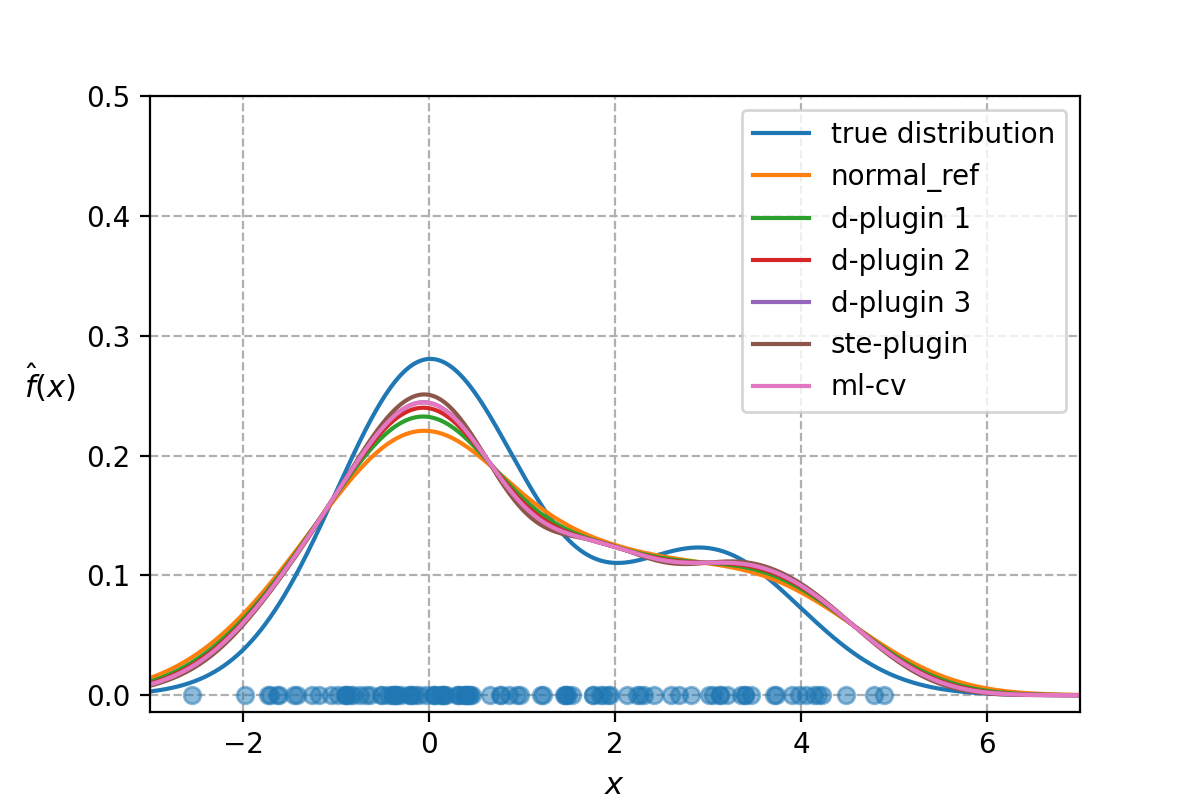
Illustration of kernel density estimations with different bandwidth selection methods computed on data drawn from gaussian mixture (blue curve):